January 15, 2026
SAM.govWhy Your SAM Profile is Missing Critical NAICS Codes
Most contractors update SAM.gov only at renewal. That gap quietly blocks visibility in buyer searches and can cost qualified firms their next award.

Have Any Questions?
(813) 355-9295
Most capability statements are built like brochures. Federal buyers do not read them like brochures. They scan for proof: fit, credibility, and execution risk. If those signals are hard to find, even a qualified company gets set aside for a competitor with clearer positioning.
A strong capability statement is not about sounding polished. It is about making procurement decisions easier for the person reviewing your document under time pressure.
Capability statements usually show up in one of four situations:
In each case, the reviewer is asking a simple question: *Can this firm do this work with low execution risk?* Your format and language should answer that directly.
Phrases like "trusted provider," "innovative solutions," and "commitment to excellence" consume space without reducing buyer uncertainty.
What to do instead:
Example shift:
If your NAICS and PSC references do not align with your registrations and recent performance, reviewers see avoidable risk.
What to do instead:
For reference, keep your SAM entity data current in SAM.gov.
"Provided program support" does not help a buyer compare you against alternatives. Include details that help someone assess relevance quickly.
Use a compact structure for each example:
When confidentiality limits details, state that directly and still provide operational outcomes.
A surprising number of statements fail on basics: stale emails, unanswered phone lines, or missing identifiers.
Minimum identity block:
If a buyer cannot route your information internally, your document is functionally unusable.
A single "master PDF" for every pursuit usually underperforms. Agencies prioritize different mission outcomes, buying patterns, and vocabulary.
What to do instead:
This does not require a full redesign each time. It requires disciplined, high-value customization.
Use this sequence whenever you update your statement:
Then hand the document to someone outside your team and ask: "Can you tell what we do, where we have done it, and why we are low risk in under 20 seconds?" If not, simplify again.
If you do not yet have deep prime past performance, use adjacent proof:
Be honest about maturity. Buyers are comfortable with emerging contractors when the scope claim is credible and specific.
Schedule your consultation below and we will align your message, evidence, and format to how federal teams actually review vendors.
Pick a time that works for you and book directly on our calendar.
Most contractors update SAM.gov only at renewal. That gap quietly blocks visibility in buyer searches and can cost qualified firms their next award.
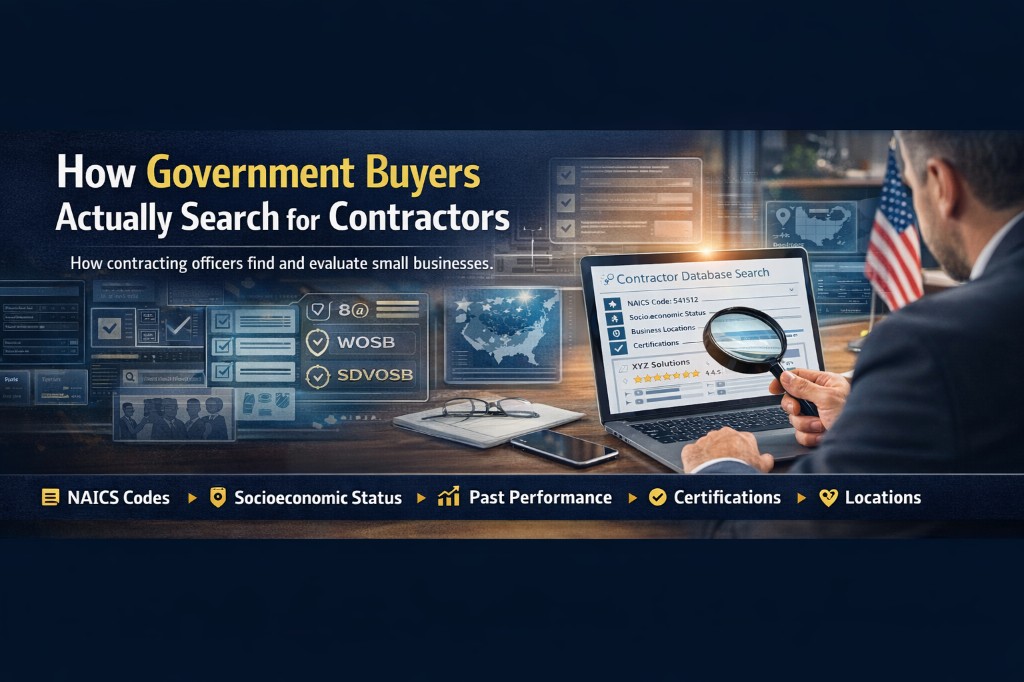
If you want more federal opportunities, optimize for how buyers run market research. This breakdown shows where visibility is won or lost before solicitations are released.
The SBA Small Business Search profile is one of the few free channels buyers use for set-aside market research. Most firms underuse it and lose visibility they already paid for in effort.