January 15, 2026
SAM.govWhy Your SAM Profile is Missing Critical NAICS Codes
Most contractors update SAM.gov only at renewal. That gap quietly blocks visibility in buyer searches and can cost qualified firms their next award.

Have Any Questions?
(813) 355-9295
Contractors often focus on opportunity feeds, proposal calendars, and bid/no-bid gates. Those are important. But visibility starts earlier, during market research, when buyers are deciding whether enough qualified firms exist for a competitive approach and potential set-aside.
If your company is hard to discover at that stage, you may never see the most valuable opportunities in a way that gives you time to position effectively.
Federal market research can use multiple systems depending on agency process and acquisition type. The common stack includes:
No single system decides everything, but weak data in one place tends to weaken your profile everywhere else.
Here is a practical version of what many acquisition teams do before release:
The team clarifies mission need, performance constraints, and likely procurement route. At this point, NAICS selection and set-aside strategy start to take shape.
Program and contracting teams need evidence that qualified small businesses exist. They look for firms with relevant capability signals and enough delivery credibility to reduce execution risk.
Common filters include:
Buyers do not do deep vendor research on every record. They scan quickly for relevance, clarity, and proof. If key information is difficult to verify, the firm is often dropped.
For promising firms, buyers may request capability statements, schedule capability briefings, or coordinate with small business offices for additional validation.
Three assumptions routinely cause visibility issues:
Visibility depends on data quality, consistency, and timing.
Use codes you can defend with actual performance. Overly broad code sets look less credible than focused, supportable coverage.
Use terms buyers expect to see in requirements, statements of work, and evaluation narratives. Avoid internal jargon that does not translate to procurement context.
Every profile should make it easy to answer:
If your SAM record, SBA profile, website, and capability statement tell different stories, reviewers assume process immaturity. Keep them aligned.
If your team wants practical momentum, run this sprint:
Week 1:
Week 2:
Week 3:
Week 4:
This cadence is manageable for small teams and creates measurable improvement in discoverability.
New contractors should prioritize clarity and truthful scope claims over breadth. Experienced contractors should prioritize profile synchronization and relevance refresh after each major award cycle.
Both groups benefit from the same principle: make buyer decisions easier.
Schedule your consultation below for a buyer-view assessment of your current visibility and where your profile helps or hurts early-stage federal market research.
Pick a time that works for you and book directly on our calendar.
Most contractors update SAM.gov only at renewal. That gap quietly blocks visibility in buyer searches and can cost qualified firms their next award.
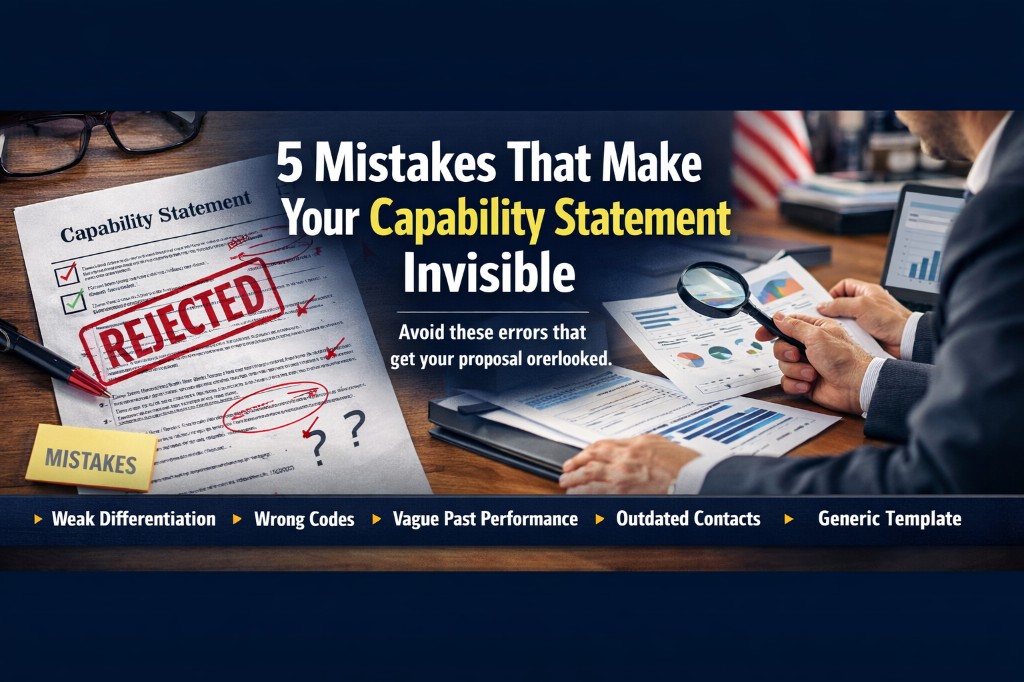
Capability statements fail less from design and more from weak positioning. These five common mistakes tell buyers you are not ready, even when your team is qualified.
The SBA Small Business Search profile is one of the few free channels buyers use for set-aside market research. Most firms underuse it and lose visibility they already paid for in effort.